What Happens to Your Family's Finances After a Cancer Diagnosis?

By Roselle Mendez
Licensed Financial Advisor, Pru Life UK · October 28, 2026 · 7 min read
Nobody plans for the day a doctor says the word cancer. But for thousands of Filipino families every year, that day comes anyway. And right after the fear, a second question usually follows, often said quietly: Paano na ang gastos?
This post won't scare you. It's here to help you understand what a diagnosis really means for a family's finances, and what you can do now, while you're healthy, so that question never has to keep you up at night.
Cancer is closer than we think
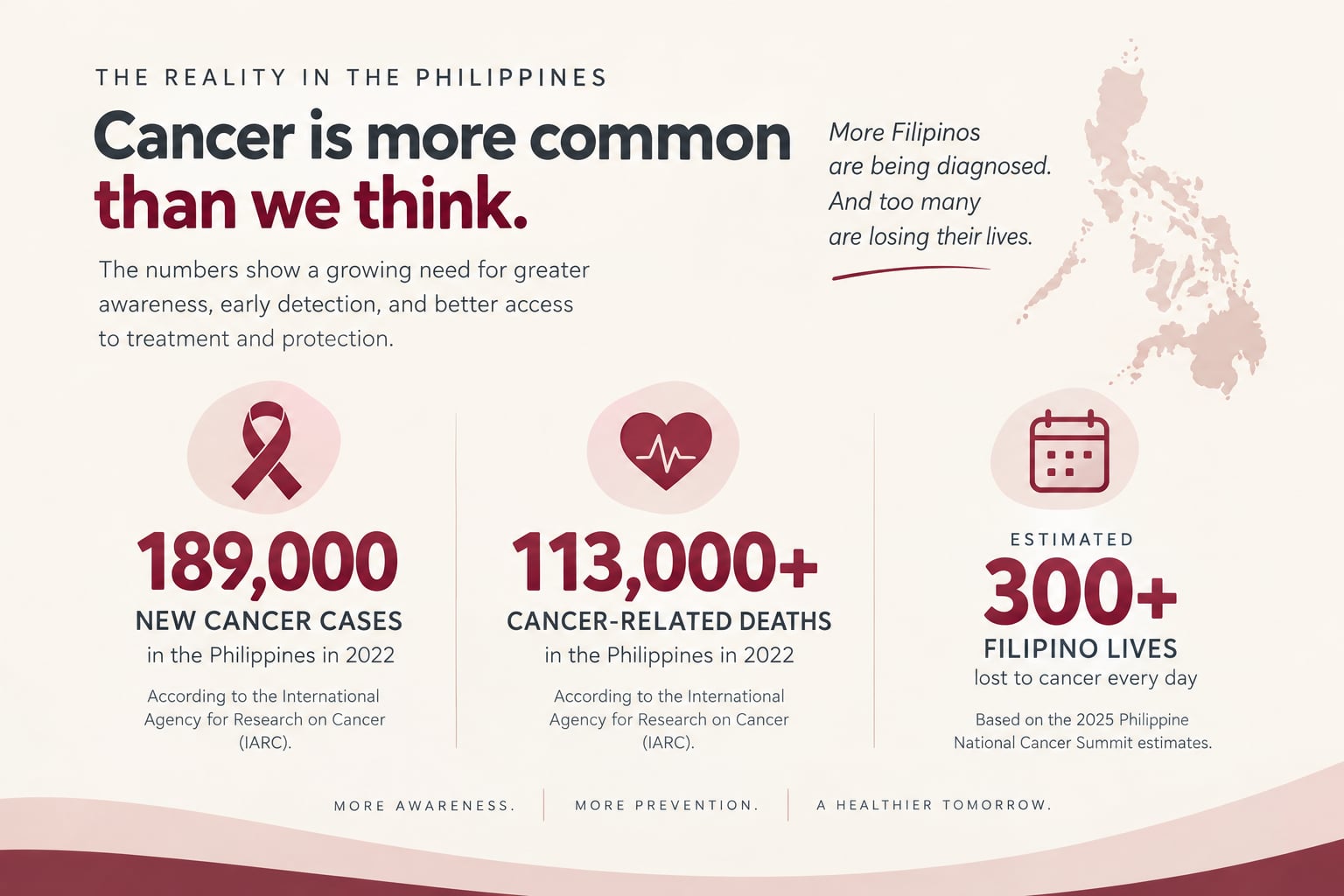
According to the International Agency for Research on Cancer, the Philippines recorded nearly 189,000 new cancer cases and more than 113,000 cancer-related deaths in 2022. The 2025 Philippine National Cancer Summit estimates that cancer takes more than 300 Filipino lives every day.
The most common cancers are ones we all know someone has faced. Breast cancer is the most common cancer among Filipino women and their leading cause of cancer death. Among Filipino men, lung cancer is both the most frequently diagnosed and the deadliest.
Behind every one of those numbers is a family adjusting to a new reality: hospital schedules, treatment decisions, and money questions that arrive all at once.
Early-stage vs. late-stage: why the difference matters
Not all cancer diagnoses are the same, and understanding the stages helps you understand both treatment and protection.
Early-stage cancer is found before it has spread or invaded deeper tissue. Examples include carcinoma in situ (abnormal cells that haven't spread beyond where they started), and early forms of prostate, thyroid, bladder and skin (melanoma) cancer. This is often the most treatable stage, which is why regular check-ups and screenings matter so much.
Late-stage cancer is a malignant tumour that has grown and invaded surrounding tissue. Leukemia, lymphoma and sarcoma also fall under this category. Treatment is usually longer and more intensive.
Stage IV, or metastatic cancer, means the cancer has spread to distant parts of the body. This is the hardest stage to treat, and usually the most expensive.
The good news: catching cancer early changes everything. The hard truth: even early-stage treatment can strain a family's budget.
The real cost isn't just the hospital bill
When families think about cancer costs, they picture chemotherapy and surgery. Those are real and they're big. But the full cost of a diagnosis usually includes much more:
- Treatment — surgery, chemotherapy, radiation, targeted or immunotherapy, and the tests in between.
- Lost income — months away from work during treatment and recovery, for the patient and sometimes for the family member caring for them.
- The costs nobody lists — maintenance medicines, travel to and from treatment, special food, a caregiver, and household bills that don't pause.
PhilHealth and an HMO help, and every family should keep theirs active. But both are designed to cover part of the medical bill. Neither replaces your income while you recover, and an HMO usually has a yearly limit that a serious illness can use up quickly.
That gap is where family savings disappear. It's where the education fund gets used, the house gets mortgaged, and relatives start a fundraiser.
Want to see your own numbers? Try our free Critical Illness Cost Calculator. It adds up treatment, lost income and recovery costs, then shows how much your current coverage leaves uncovered. No sign-up needed.
Open the calculator →How a cancer plan is different from a health card
A health card or HMO pays the hospital for covered treatment. A cancer protection plan works differently: it pays you a lump sum in cash when you're diagnosed with a covered cancer.
That difference matters more than it sounds. Cash in hand means you decide how to use it: a second opinion, a treatment your HMO doesn't fully cover, replacing your salary while you recover, or simply keeping your family's life stable while you focus on getting better.
A closer look: PRUCare Cancer Protect

PRUCare Cancer Protect plan overview
PRUCare Cancer Protect is a 10-year renewable term plan built specifically around cancer — designed to be simple to start and to renew.
One option worth knowing about is PRUCare Cancer Protect from Pru Life UK. It's a 10-year renewable term plan built specifically around cancer, and it was designed to be simple to start. Here's how it works:
- 50% of your coverage on early-stage diagnosis. If you're diagnosed with a covered early-stage cancer, you receive half your coverage amount in advance, and your policy continues as long as premiums are paid.
- 100% on late-stage diagnosis. A covered late-stage cancer pays your full coverage amount, minus any early-stage benefit already paid.
- An extra 20% for catastrophic cancer. If the late-stage cancer is Stage IV with distant spread (or a grade III/IV glioma brain tumour), you receive an additional 20% of your coverage on top of the late-stage benefit.
- Life insurance included. If you pass away from any cause, not just cancer, your family receives 30% of your coverage amount.
- A reward for staying healthy. If you make no claims, you get back 50% of the total annual premiums you've paid, every 10 years.
- Easy to apply. Underwriting focuses on cancer, with just 4 health questions.
- Renews without re-applying. After each 10-year term, coverage renews automatically, with no new application and no new underwriting, up to age 80.
Who can apply: anyone from 30 days old to 60 years old, with a minimum coverage amount of ₱500,000. Premiums are paid for 10 years per term.
What to know before you apply
Good protection should come with no surprises, so here are the important details:
- Pre-existing conditions aren't covered. Illnesses or conditions you already have before buying the plan are excluded. That's exactly why the best time to get covered is while you're healthy.
- There's a 90-day waiting period. Cancer benefits apply to diagnoses made after 90 days from the policy start date.
- Late-stage benefits end the policy. Once the late-stage benefit is paid, the policy terminates and the death benefit is no longer payable. The early-stage benefit is the only one that can be paid while the policy continues.
- You have a 15-day free-look period. If you change your mind within 15 days of receiving your policy, you get a full refund of the premium you paid.
- Read the full terms. The policy contract has the complete definitions of early-stage, late-stage and catastrophic cancer, plus other exclusions.
Is a cancer plan right for you?
A cancer plan is worth a serious look if:
- Your family depends on your income, and a long recovery would put that at risk.
- Cancer runs in your family, and you'd rather prepare than worry.
- You already have life insurance or an HMO, but nothing that pays cash on diagnosis.
- You want simple, focused protection you can start quickly, even on a modest budget.
It may not be the only protection you need. Many families pair a cancer plan with life insurance and broader critical illness coverage, depending on their budget and goals. The right mix depends on your age, your family and what you already have.
The best time to prepare is before you need to
Cancer protection is priced on your age and health today, and pre-existing conditions are never covered. Every year you wait makes coverage cost more, and a single finding at your next check-up can make it harder to get at all.
If this post got you thinking, let's talk it through. I'll walk you through what a cancer diagnosis could cost your family, what you already have in place, and whether PRUCare Cancer Protect, or another plan, fits your budget. Twenty minutes, free, and no pressure.
Want this protection for your family?
Leave your details below and we'll follow up with a tailored recommendation — then you can pick a time for a free 20-minute assessment. No pressure, no obligation.
Roselle Mendez is a licensed financial advisor of Pru Life UK. This article is for general information only and does not constitute financial or medical advice. PRUCare Cancer Protect is underwritten by Pru Life Insurance Corporation of U.K. (Pru Life UK). Benefits are subject to the terms, conditions, definitions and exclusions in the policy contract, and coverage is subject to underwriting approval. Cancer statistics are from the International Agency for Research on Cancer (2022 estimates) and the 2025 Philippine National Cancer Summit.
Roselle Mendez
Licensed Financial Advisor, Pru Life UK
Mom, former BPO Senior Operations Manager, and Financial Advisor with Pru Life UK for over 5 years. I help Filipino families protect their income, secure their children's education, and plan for retirement — in plain language, never with pressure.
This article is for general information only and does not constitute financial or medical advice. Roselle Mendez is a licensed financial advisor of Pru Life UK. Insurance products are underwritten by Pru Life Insurance Corporation of U.K. (Pru Life UK); benefits are subject to policy terms, conditions and exclusions, and coverage is subject to underwriting approval.
Want to talk it through?
A free 20-minute assessment — no pressure.